
Research
Ongoing Research In RCHT ED
We are currently involved in two research projects in ED; NAP8, TICH-3 and DRAFT3 – CASP. Please scroll down for details.
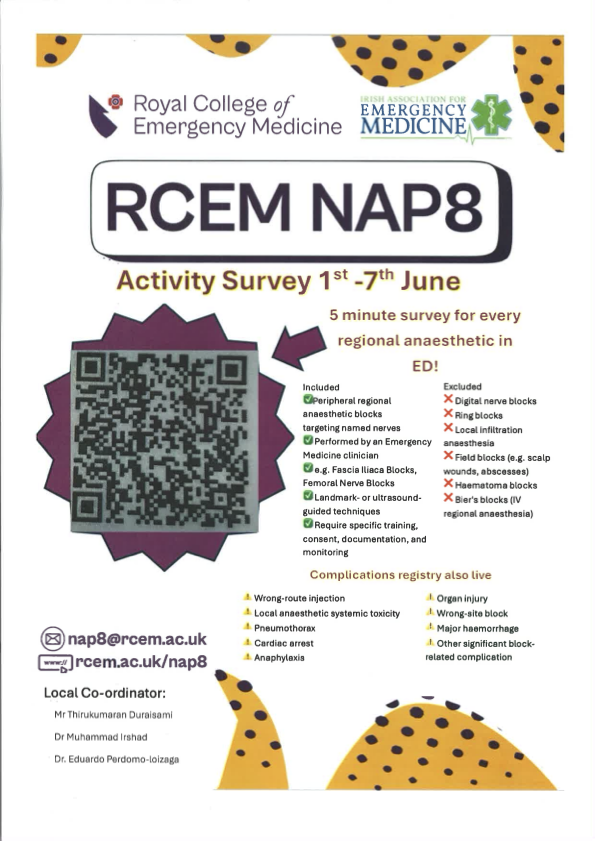
NAP8
The National Audit Project 8 (NAP8), led by the Royal College of Anaesthetists and the Royal College of Emergency Medicine, evaluates the safety and provision of regional anaesthesia in Emergency Departments across the UK and Ireland. It utilizes a 12-month registry and surveys to track major complications, such as nerve injuries and Local Anaesthetic Systemic Toxicity (LAST), amidst rising litigation related to peripheral nerve blocks.
TICH-3
Research summary
ICH is a medical emergency and causes more than 1.7 million strokes worldwide per year3, 4 with a mortality of over 40%.5 More than 10,000 people suffered an ICH last year in England. There is no effective drug treatment for ICH, and only a small proportion of patients benefit from surgery. Haematoma growth is common, occurs early,6, 7 and is the commonest cause of death after ICH. It can potentially be prevented by haemostatic therapies, which are effective in other bleeding conditions.
TICH-3 documents (nottingham.ac.uk)
Time from symptom onset, baseline haematoma growth and anti-thrombotic therapy use are all independent predictors of haematoma growth.10 The Computed Tomography (CT) spot sign can also improve the prediction model but has not been successful in previous trials11 and is not routinely performed in clinical practice.
ICH related disability causes massive burdens to the affected individual, their family and society. ICH was identified as a priority research area by The Stroke Association, with interventions to stop bleeding as a treatment target.12 The incidence of ICH is increasing due to high blood pressure and the ageing population, with ICH-related death and disability set to rise.13, 14 Recent improvements in stroke pathways have led to rapid imaging, with early diagnosis providing an opportunity to rapidly administer treatments. Implementation of an effective haemostatic therapy such as tranexamic acid (TXA) is therefore possible in ICH.
The proposed study will build on experience from the NIHR HTA funded TICH-2 trial,15 streamline trial methods and enable rapid enrolment of those most likely to benefit. If the haemostatic effect demonstrated in TICH-2 (with reduction in early death) is confirmed in TICH-3, this could change clinical practice globally. By enrolling participants earlier and excluding those with established large HVs, TICH-3 targets patients with the greatest potential to benefit.
DRAFT3 – CASP
This trial aims to compare two treatment methods that are currently standard care for treating wrist fractures. There are a large number of wrist fractures every year in the UK and by comparing the clinical and cost effectiveness of the treatments, this could help save money for the NHS.
https://www.ndorms.ox.ac.uk/research/clinical-trials/current-trials-and-studies/draft-2013-casp
SUMMARY
Usual care for this population is to provide the patients with a temporary backslab plaster cast in the emergency department. The patient would then be referred to the fracture clinic where this cast is converted into a full, circumferential cast. The patient will then return at around 4-6 weeks to have this cast removed.
Some evidence has recently shown that a removable wrist splint may provide the same support as a cast whilst the fracture heals. The splint can be removed by the patient themselves and so would not require the patient to return to hospital and could save money for the NHS. However, if the splint does not provide patients the same support as a cast, the patient may have inferior function in their wrist.
This study aims to recruit a minimum of 1894 participants across 36 centres. The participants will be followed-up for 1 year following their recruitment to the trial and will complete a series of questionnaires in order to record their health related quality of life, wrist function and any costs incurred to them as a result of their injury.
The trial will help us find out if a removable splint can provide the same support as a plaster cast for undisplaced distal radius fractures.